
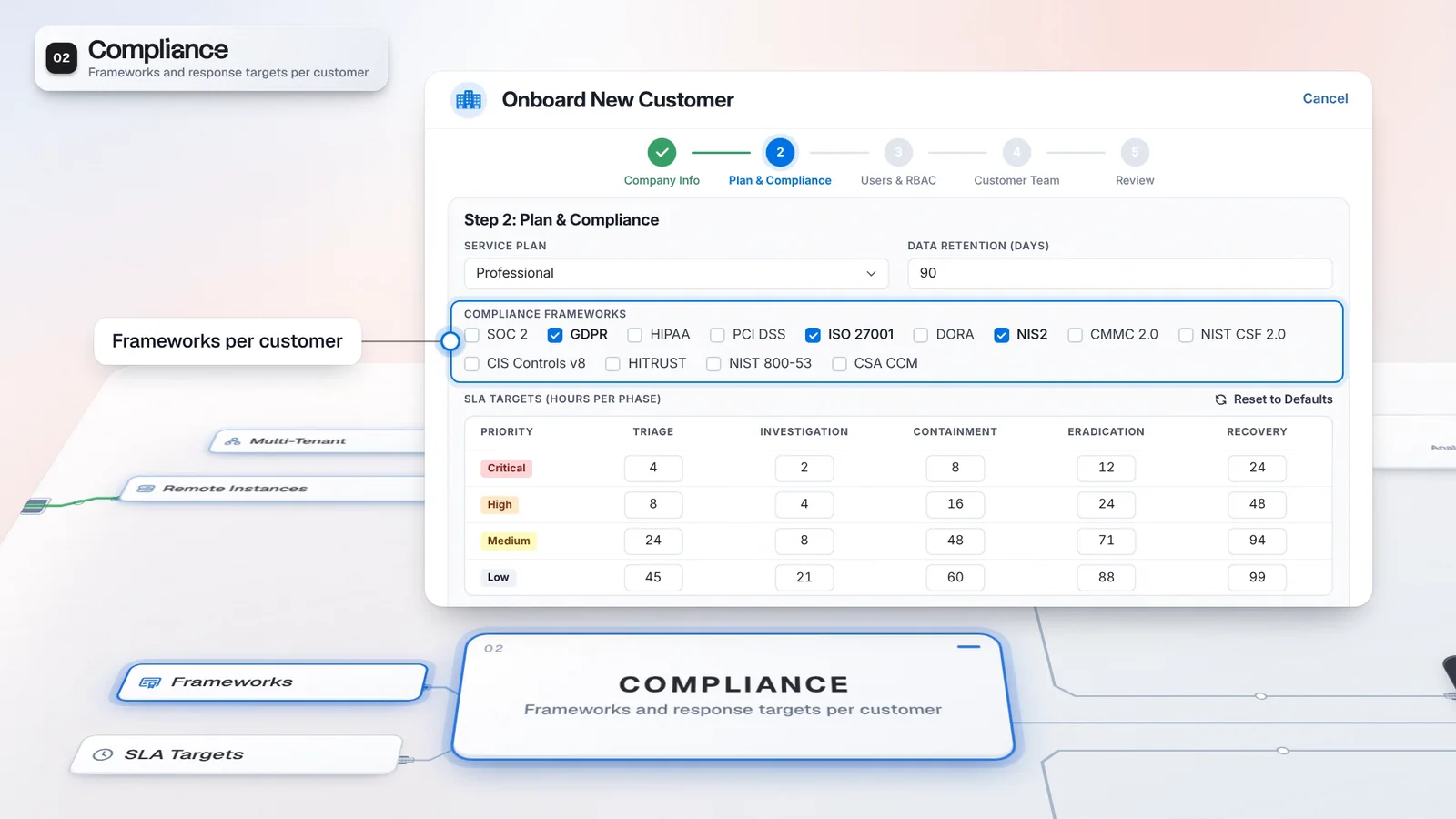
 Start with onboarding
A named next action
Assign a task where the team is already coordinating the incident.
Coordinate participants and tasks in the case's War Room, with the investigation close at hand. Your team can run available playbooks from the case when permitted and review execution status alongside the evidence, so follow-up work stays connected to the incident it serves.

 A. RiveraA. Rivera
A. Rivera: Sign-in logs are attached to the case.
A. RiveraA. RiveraM. KayaM. Kaya A. RiveraJ. Dahl, please review the sign-in evidence.J. DahlI will review the case and coordinate with M. Kaya.M. KayaThe reset task is assigned to me.
Reset the service account remains assigned to M. Kaya.
A. RiveraA. RiveraM. KayaM. Kaya: Checking the playbook execution before updating the case.
A. RiveraReview execution status alongside the case evidence.
A. Rivera and M. Kaya coordinate the Northstar investigation in its War Room.
Add a task to reset the service account and assign it to M. Kaya.
Bring J. Dahl, an internal analyst, into the response team.
Run an available playbook from the case when permitted, then check its execution status.
An incident needs coordination as well as evidence. The War Room gives your team a place on the case to coordinate participants and tasks, so the next analyst can pick up the work in context.
Use the task list to give follow-up work an owner. The War Room sits on the case, beside the evidence and notes used in the investigation. Review permitted playbook execution there too, so the incoming analyst can see the outstanding work and its context at handoff.
The coordination happens on the case, so the incident record is complete.
Illustrative customer and values. Not customer performance data.
Assign a task where the team is already coordinating the incident.
Return to the case for tasks and the investigation that prompted them.
Start from the customer case your team is working. Use its War Room to coordinate the response, then review permitted playbook execution without separating the action from the investigation.
Open the customer case and review the evidence already attached to it.
Coordinate the participants and tasks for this incident.
Assign follow-up work to an analyst so its owner is clear.
Run an available playbook when permitted and review its execution status.
Casebook comes with every tier. Available playbooks depend on the enabled modules and permissions; playbook automation is outside The Portal's default module set.
Casebook holds the investigation record. Automatio provides playbook workflows where licensed, while Virtus Pilot supports investigation where its module is enabled. The War Room gives your team a place to coordinate the human work.
Casebook is included. Playbook and AI capabilities follow their own module entitlements.
Keep coordination attached to the incident while the response is under way. When the case closes, its evidence and recorded decision give your team a basis for review instead of a fresh reconstruction.
Find tasks beside the investigation instead of collecting a separate task list.
Check playbook execution status alongside the case that prompted the run.
Use the case evidence and closure reason to explain the recorded outcome.
Open a case with a follow-up action your team needs to coordinate.
Make the task and its owner explicit in the War Room.
Check execution status and write a useful closure reason when the work is done.
The case's War Room holds the task list for coordinating incident work. Participants and tasks stay on the case, close to its investigation context.
Run available playbooks from the case when permitted, then review execution status alongside the investigation. Playbook availability depends on enabled modules and permissions; playbook automation is outside The Portal's default module set.
A closed case can retain its evidence, timeline, disposition and closure reason for review. Closing a case is distinct from deleting it; a useful closure reason helps the next analyst understand the decision.
Have any other questions? Talk to our team
Walk through incident coordination and permitted playbook execution with the Imperum team.