
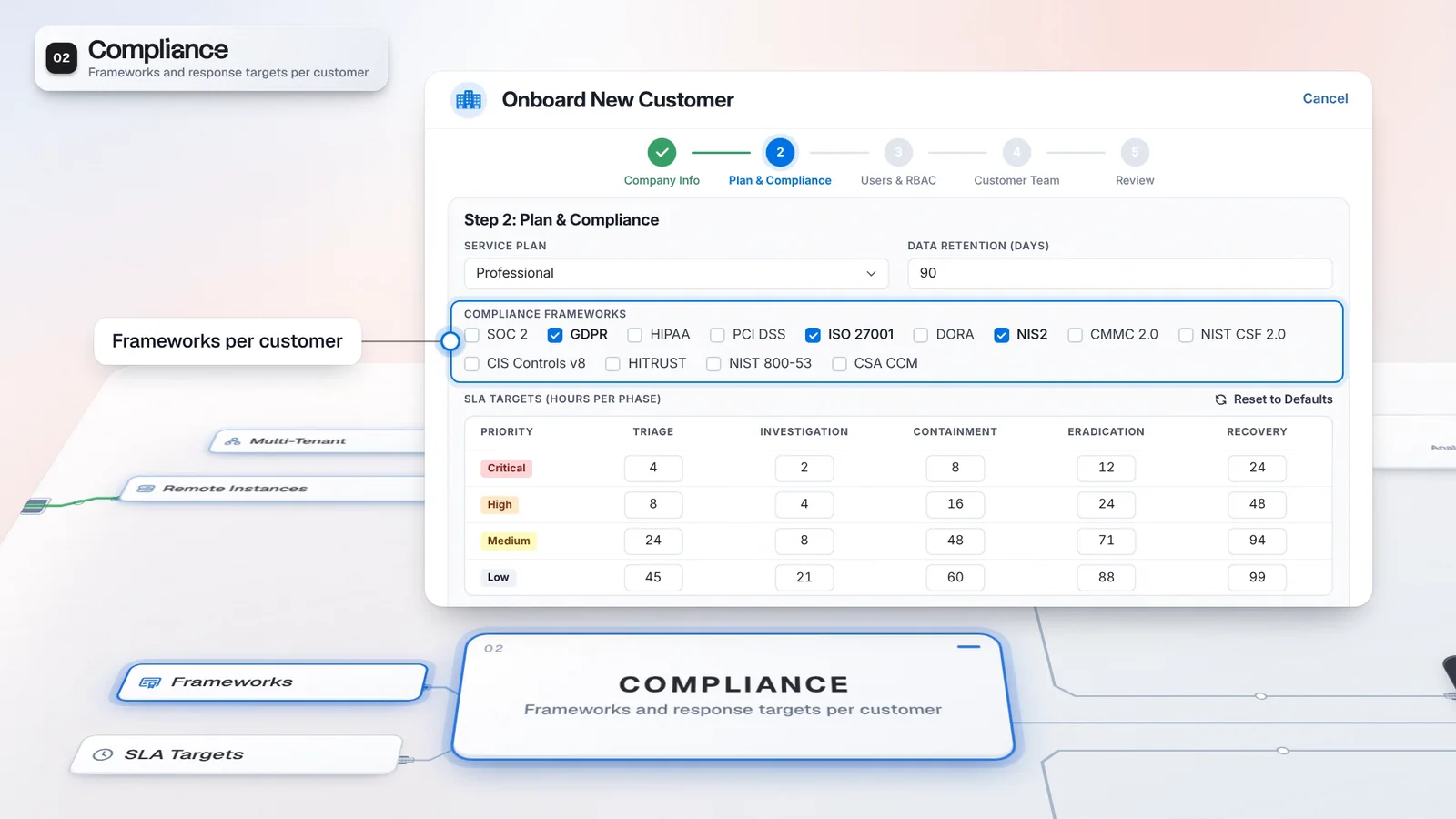
 Start with onboarding


Choose where it runs
Use the deployment footprint that fits the customer’s policy.
The whole platform, including the AI, runs on-premises, in your cloud, hybrid or fully air-gapped with local models. Agree the required modules and reachable integrations in the deployment design, then validate the customer workflows against that environment before putting the service into operation.
Confirm each required workflow against the environment’s constraints.
Capacity and availability requirements belong in the deployment design.
The provider build enables multi-tenant operation.
Review the full provider chain for each required workflow.
Confirm each required workflow against the environment’s constraints.
Illustrative planning checks, not live diagnostic results.
Confirm each required workflow against the environment’s constraints.
Choose an air-gapped footprint for the illustrated provider deployment.
The provider build uses a search index cluster and a Virtus AI Engine configuration for horizontal API scaling.
Plan local model endpoints and the routes used by licensed AI features.
Check the required modules, model endpoints and reachable integrations against the agreed air-gapped design.
Choose the hosting footprint before connecting the customer’s workflow. The platform supports on-premises, cloud, hybrid and fully air-gapped environments, with local models available for work that needs to stay inside the deployment.
The full platform and the models behind its AI can install inside your environment. Cloud and hybrid deployments use the same platform with the hosting location changed. For an air-gapped design, agree local model endpoints and reachable integrations alongside the required modules, installation packages and updates. Validate the intended workflows against those constraints before committing to the architecture.
Your team keeps the same platform across supported deployment footprints.
Illustrative customer and configuration. Not customer performance data.
Use the deployment footprint that fits the customer’s policy.
The provider build clusters the search index and configures the AI engine for horizontal API scaling.
Hosting location is one part of the design. Model routes and integration reachability determine whether the intended service works within that environment, especially when the deployment cannot reach external services.
Agree the footprint, enabled modules, installation packages and update approach.
Configure local model endpoints and review the route for each licensed AI feature.
Configure the supported integrations reachable from the environment and review the reported test results.
Set up customer tenants and profiles after the deployment design is agreed.
For air-gapped environments, agree the required modules, local model endpoints and reachable integrations in the deployment design. Validate each required workflow against those constraints.
AI Fabric supplies model configuration and routing. Integrations supplies access to the customer’s tools. Review both when deciding what the service can run in an on-premises, cloud, hybrid or air-gapped environment.
Agreed in the deployment design; enabled modules follow the license.
Use the same platform across on-premises, cloud, hybrid and air-gapped footprints. Validate model routes and tool access before committing, so the workflows in your proposal fit the agreed environment.
Choose among supported footprints around the customer’s requirements.
Check model endpoints and integrations against the intended data boundary.
Use a validated workflow to review the deployment design together.
List the tools and licensed AI capabilities it needs.
Agree hosting, local models and the connections the environment can reach.
Test the workflow against those constraints before committing to the architecture.
You configure the model providers and their endpoints, including supported cloud services and locally hosted models. Virtus routing can assign different provider chains to features such as Triage and Pilot, with configured fallbacks. Data follows the selected route, so review the full chain when setting residency requirements. Local model hosting alone does not describe every integration’s data flow.
Imperum can work alongside an existing SIEM or EDR through configured integrations. Those connections can supply alerts and make supported actions available to investigations and playbooks. Coverage depends on the connector, credentials and configuration, so validate the tools and workflows you want to retain.
The provider build supports multi-tenant operation with a search index cluster and a Virtus AI Engine configuration for horizontal API scaling. Agree the footprint, licensed modules and reachable integrations in the deployment design; the build does not establish a customer capacity or availability commitment.
Agree the required modules, local model endpoints, installation packages, updates and reachable integrations. Include endpoint connectivity and evidence storage when forensic collection is required, and confirm each workflow against those constraints before committing to the architecture.
Have any other questions? Talk to our team
Review the footprint, local models and tool access your customer workflows require.