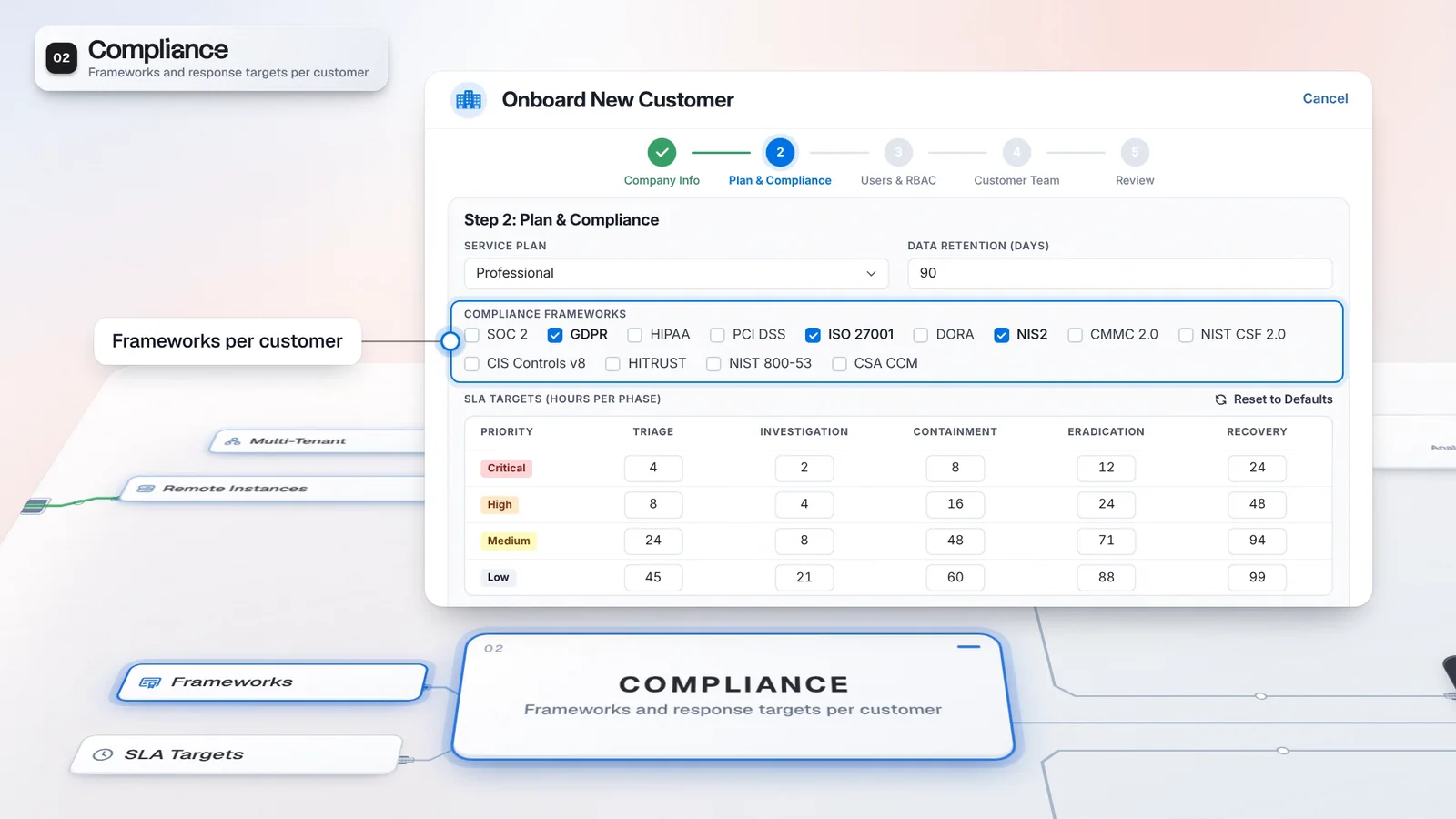
 Start with onboarding





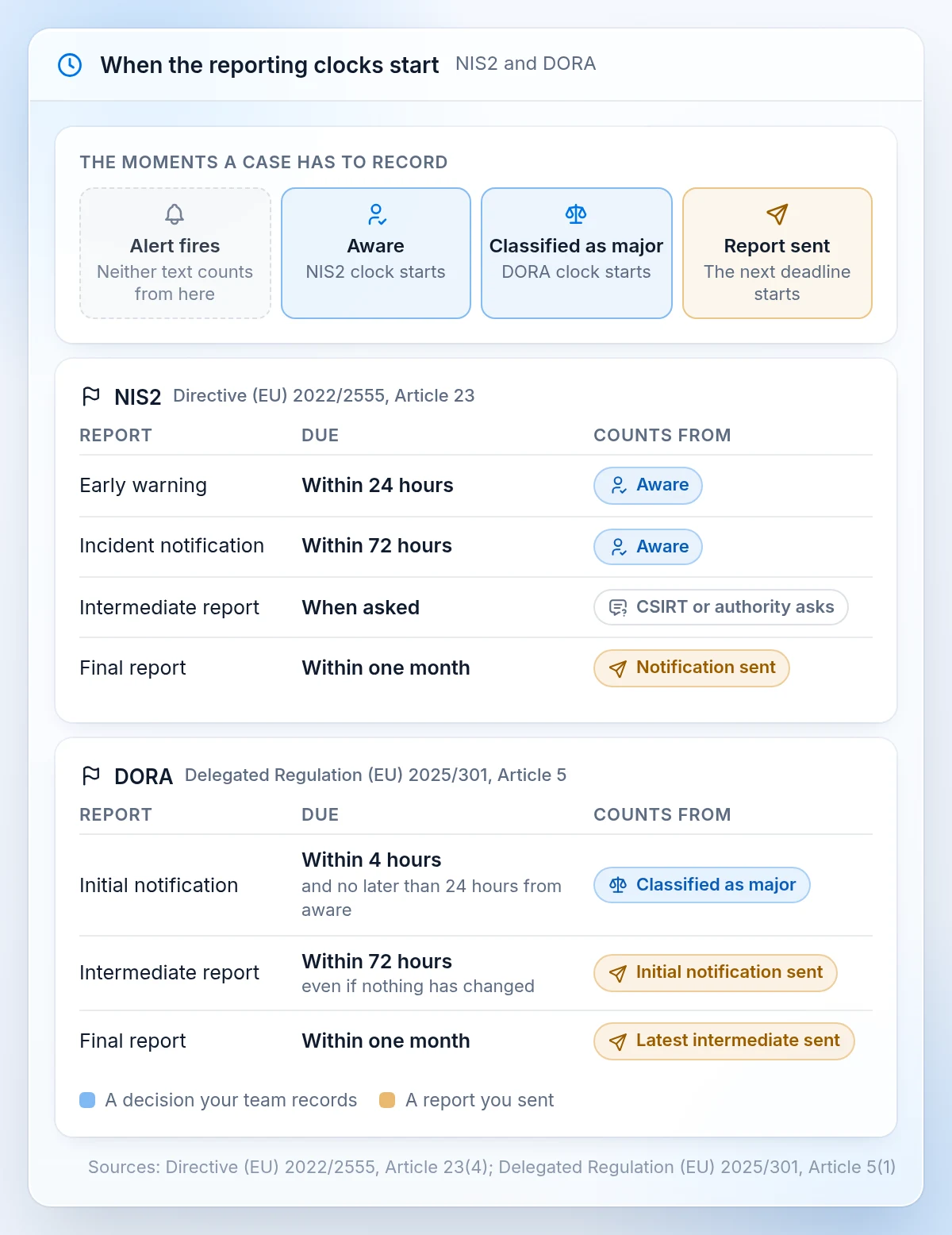
NIS2's 24 hours covers only an early warning, counted from when you become aware of a significant incident. DORA's 4 hours count from classifying an incident as major, and its later reports count from the one sent before. Neither text counts from the first alert, so security case management for NIS2 and DORA means recording those moments on the case.
Does NIS2 mean you report every incident within 24 hours?
No. Only a significant incident is reportable, and the 24 hours covers only an early warning. Article 23 of NIS2, the EU's cybersecurity directive, calls an incident significant when it has caused or can cause "severe operational disruption of the services or financial loss", or "considerable material or non-material damage" to others.
The early warning is due "within 24 hours of becoming aware of the significant incident". The incident notification, with an initial assessment of severity and impact, is due within 72 hours of becoming aware. The CSIRT, the national computer security incident response team, or the authority can ask for an intermediate report.
The final report is due "not later than one month after the submission of the incident notification", so the month counts from that submission. An incident still ongoing at that point gets a progress report first, and the final report within one month of handling it.
When does the NIS2 clock start?
When the entity becomes aware of the significant incident. For managed security service providers (MSSPs), cloud providers and other digital service providers, the Commission's implementing regulation explains the moment. After a suspicious event, the entity should assess it "in a timely manner". It counts as aware "when, after such initial assessment, that entity has a reasonable degree of certainty that a significant incident has occurred." Other entities should check their national authority's reading.
Its thresholds for MSSPs include a managed security service "completely unavailable for more than 30 minutes", or service data compromised "as a result of a suspectedly malicious action". An outage can be reportable as well as an attack.
In the Netherlands, the NIS2 law, the Cyberbeveiligingswet, took effect on August 15, 2026, and the NCSC says it covers more than 8,000 organizations. Per the Dutch government's FAQ, covered organizations report through MijnNCSC, and one report reaches both the CSIRT and the supervisor.
How is DORA incident reporting different?
DORA counts from classification. For banks, insurers and other EU financial entities, the rules of DORA, the EU's digital resilience regulation for finance, have applied in place of NIS2's since January 17, 2025. Its rules on time limits, Delegated Regulation 2025/301, set three deadlines:
- Initial notification: within 4 hours of classifying the incident as major, and no later than 24 hours after becoming aware of it.
- Intermediate report: within 72 hours of submitting the initial notification, even when nothing has changed.
- Final report: no later than one month after the latest intermediate report.
If an incident is classified as major more than 24 hours after awareness, the 4 hours start at that classification. An entity that cannot meet a deadline has to tell its authority before the deadline passes and "explain the reasons for the delay."
What did the first year of DORA reports show?
Most major incidents were not cyberattacks. The European Supervisory Authorities' (ESAs) report on 2025 counts 3,383 major ICT-related incidents in 2025. System failures were reported for 51% of them, and cybersecurity incidents accounted for 10%. And 29% were caused by a failure at a third-party provider, the route of the Crédit Mutuel Arkéa attack.
About 15% of the major incidents notified in 2025 had no final report by the cutoff of February 5, 2026. The ESAs say they will focus on "open" incidents in 2026, including helping national authorities find overdue cases.
What does a reporting case need to record?
The moments each deadline counts from, and who decided each one. DORA's initial notification asks for the date and time of detection, the criteria that made the incident major, and how it was discovered. NIS2's final report asks for the likely root cause and the mitigation applied. A possibly reportable case should hold:
- when the event happened, and when it was detected
- when the team became aware, or classified it as major, and who decided
- when each report was sent, because the next deadline counts from it
- the evidence behind the decision that it is significant or major
How does security case management work, step by step in Imperum?
Security case management is the practice of keeping an incident's evidence, owners, decisions and times in one record, from the first alert to the final report. In Imperum, that record is a case. Imperum does not decide whether an incident is significant or major, does not submit reports to a CSIRT, a national portal or a supervisor, and does not replace legal review. Available modules depend on your Imperum license.
Step 1: Keep the case's times and tasks in Casebook
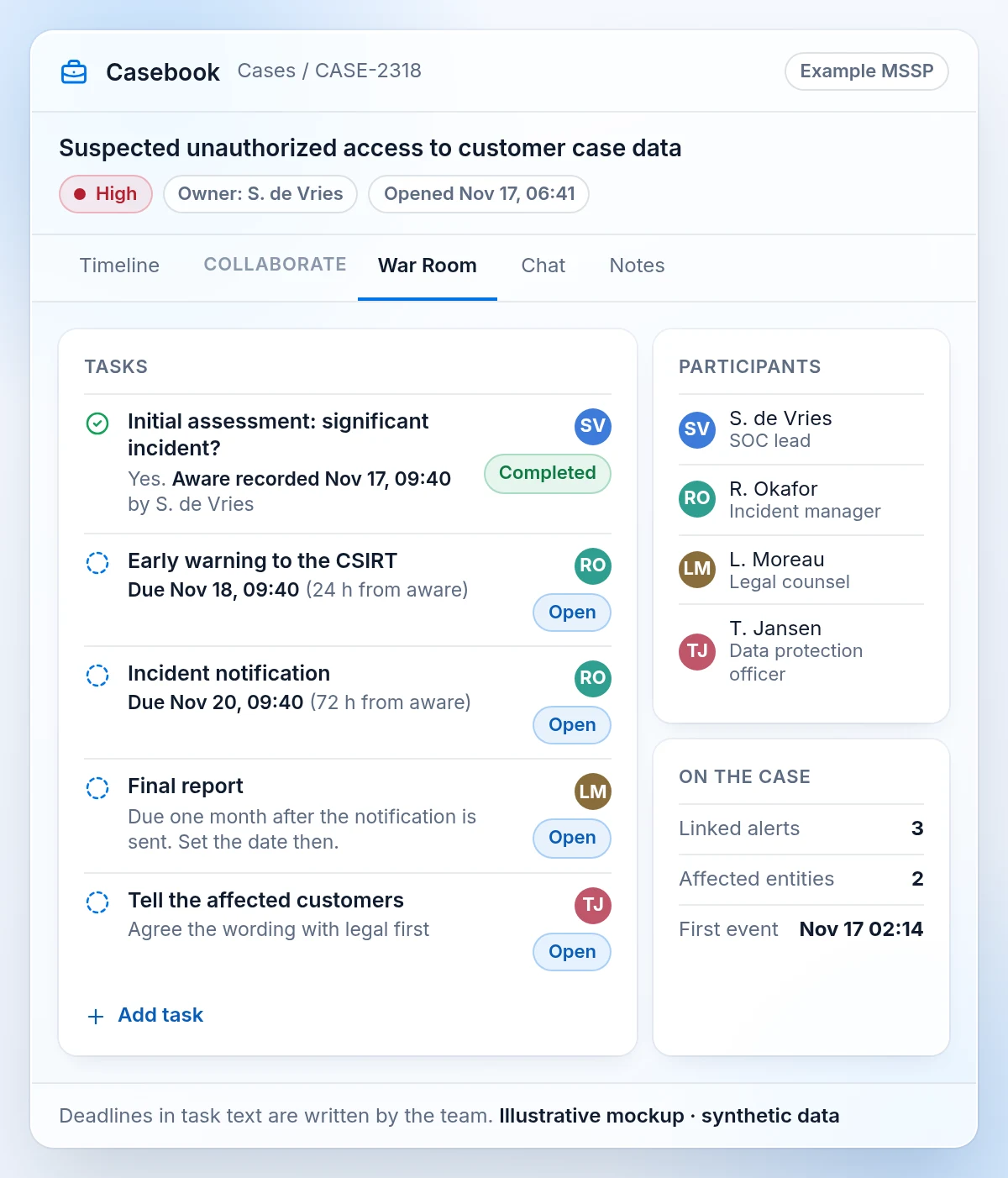
Casebook, Imperum's case management module, "brings alerts, evidence, ownership and response history into one case." The case timeline keeps the time an action was recorded in Imperum apart from the time the underlying event occurred, and event time is stored when a real source timestamp is available. The incident view labels entries without one, so a missing timestamp is visible instead of passing for the incident's time.
Use the case's War Room to coordinate participants and tasks. The significance decision and each report can be a task with an owner and the deadline your team works out written into it. "Closing a case is distinct from deleting it": the case can retain its evidence, timeline, disposition and closure reason for review.
Step 2: Put the reporting decision behind a Human Approval in Automatio
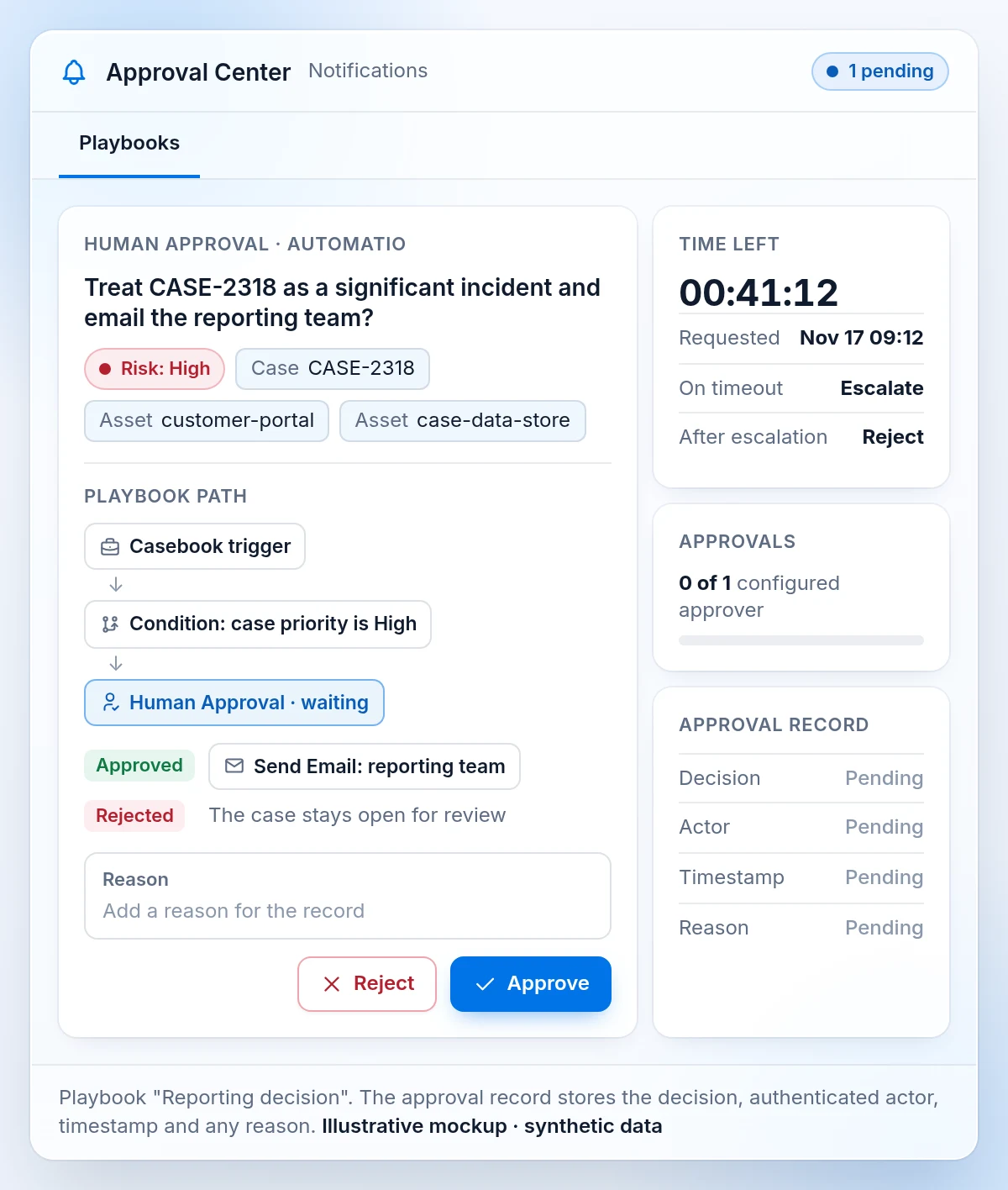
In Automatio, Imperum's playbook engine, a playbook can start from a Casebook trigger. Place a Human Approval step where a person decides whether the incident is significant or major, and on the approved branch, email the people who write the report. The approval record stores the decision, authenticated actor, timestamp and any reason.
The step appears in the Approval Center, and "The Human Approval node defaults to rejection on timeout," so configure the escalation path, or an unanswered request takes the rejected branch. A completed run does not necessarily mean the email went out, so check which branch ran.
Step 3: Assemble the record in Reports
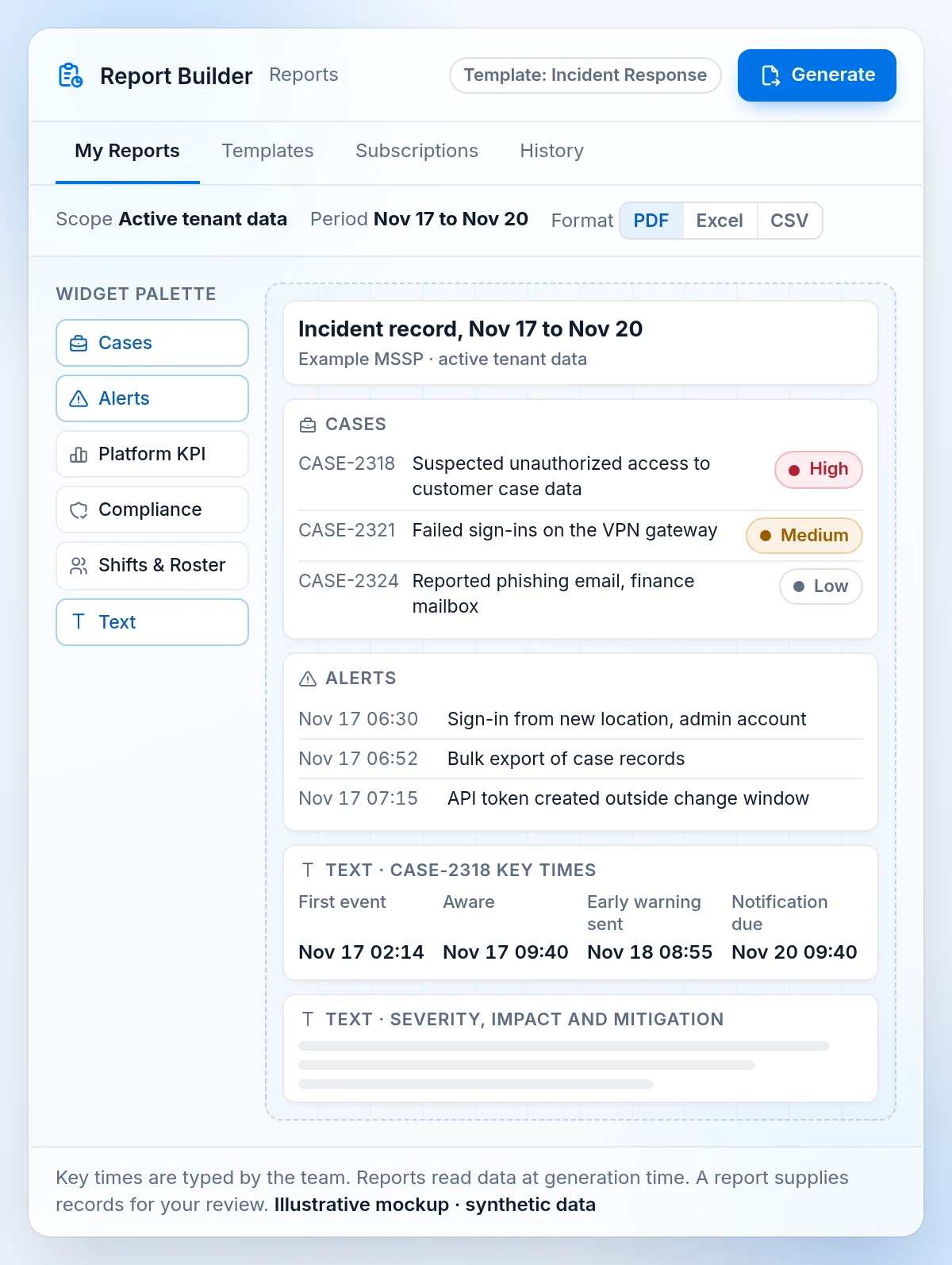
In Reports, part of Imperum's tools for SOC management and governance, start from the Incident Response template, or a framework-specific template "to organize evidence for a compliance review". Scope it to the tenant and the period, then generate an Excel or CSV file, or a PDF where a PDF renderer is available. Reports read data at generation time, so generate a fresh one for each submission.
A report or audit export supplies records for your review. Your team still writes what goes to the authority and submits it through the channel the authority sets, such as MijnNCSC in the Netherlands. This post is not legal advice: check your national law and your supervisor's guidance.
What should you check first?
- Name who decides "aware" for NIS2 and "major" for DORA, and where that moment is recorded.
- Check that your incident procedure covers system failures and third-party outages as well as security alerts.
- Set each later deadline only once the report it counts from has gone out.
- List the cases still waiting for a final report, with their due dates.
Questions about NIS2 and DORA incident reporting
What is SOC case management?
In a security operations center, case management keeps each investigation in one record: the alerts, evidence, owner, decisions and response, from the first alert to the closing reason. Under NIS2 and DORA, the record also has to hold the times the reporting deadlines count from: detection, awareness or classification, and each report sent.
Does GDPR add a third reporting clock?
Yes, when the incident is also a personal data breach. GDPR Article 33 requires the controller to notify the supervisory authority "without undue delay and, where feasible, not later than 72 hours after having become aware of it," unless the breach is unlikely to put people's rights at risk. Under GDPR, a processor tells the controller without undue delay.
Can a provider report incidents for its clients under DORA?
Under DORA, a financial entity may outsource incident reporting to a third-party provider, and it "remains fully responsible" for meeting the requirements. A provider whose failure hits several financial entities can, under conditions, submit aggregated reports on their behalf. Under NIS2, an MSSP in scope reports for itself, against its own thresholds.
Can incident response automation file the report for you?
Not in Imperum. Incident response automation can start the procedure from a case, notify the right people and pause for a human decision. Deciding whether an incident is significant or major, writing the report and submitting it stay with your team. NIS2 also says reporting should not divert people from handling the incident, so keep the early warning short.