
 Start with onboarding




On November 24, Check Point Research named Volant Manticore, an Iran-nexus group it believes is made up of former MuddyWater operators using a retired MuddyWater toolkit. It assesses a fake CV was aimed at a Cyprus airline; Cyprus says no breach was found. For teams that track APT groups, the name matters: filing it under MuddyWater could leave blind spots.
What is Volant Manticore, and what did it do?
Volant Manticore is an espionage group that Check Point Research (CPR) first described on November 24, 2026. CPR assesses "with high confidence" that it is Iran-nexus, and "with medium confidence" that it is at least historically linked to Iran's Ministry of Intelligence and Security (MOIS). CPR believes it is the first Iranian group to make Cyprus a primary espionage target, focusing on telecommunications companies, airlines and critical infrastructure.
The research started with a file on VirusTotal: a fake CV for an AI-generated tourism professional based in Cyprus. The CV offers the full version on a real recruitment website, but the link leads to an archive on the Catbox file host that installs a new backdoor, KuboShell. CPR assesses the attempt "was aimed at a Cyprus-based airline whose business centers on flights between Cyprus and Israel."
KuboShell is a 64-bit Windows backdoor. It takes its orders through IPFS, a peer-to-peer file-sharing network, by way of the commercial Pinata service, and checks for a new command every 60 seconds. CPR also ties a January 2026 Word lure, MilitaryHeritageProposal.doc, to a likely Cypriot government target. It found servers for credential harvesting, and the group deployed three legitimate remote management tools: NetLock RMM, N-able RMM and MeshCentral. In September 2026 it abruptly turned to healthcare organizations in Saudi Arabia.
None of this is exotic for a European SOC. ENISA's Threat Landscape 2025 analyzed 4,875 incidents from July 2024 to June 2025 and found phishing was the most common way in, at 60%, while state-aligned threat groups "steadily intensified their operations towards EU organisations." The practical question for a SOC: is this group already in our intelligence, and what do we look for?
Is Volant Manticore new, or MuddyWater under another name?
Volant Manticore is most likely a spin-off: CPR assesses "with medium confidence" that it is "a separate, independent group composed of former MuddyWater operators." MITRE ATT&CK describes MuddyWater as "a cyber espionage group assessed to be a subordinate element within Iran's Ministry of Intelligence and Security," tracks it as G0069 and lists aliases such as Static Kitten, Mango Sandstorm, Seedworm and TA450.
The link is in the tools. CPR assesses that the group's Homa framework client is "a JavaScript reimplementation of the older MuddyC2Go client," which MuddyWater replaced in late 2023. CPR weighed six explanations, from the same actor to a copycat, and argues that "a copycat would most likely imitate MuddyWater's latest documented tooling, not a retired framework."
In CPR's words, "Treating Volant Manticore as part of MuddyWater could therefore lead to blind spots, particularly for organizations in Saudi Arabia and Cyprus." One question stays open: CPR "cannot rule out that Volant Manticore now operates under a different Iranian entity."
What did early reports get wrong?
- Two headlines said the hackers "target airlines and hospitals." Targeting is not a breach: CPR found the CV on VirusTotal and assesses one airline was the intended target. Cyprus's deputy minister for digital policy, Nikodimos Damianou, told Alpha News the competent services examined the reports and no breach emerged.
- One report said the CV "was sent to" the airline. CPR's introduction says "delivered to"; its analysis says only "was aimed at."
- A headline about hackers "using AI" overstates it: the AI-generated part is the fake applicant.
- Check Point's blog summary says the operators "don't rely on an older MuddyWater framework." The research says "Volant Manticore relies on an older MuddyWater framework."
- In the same interview, Damianou mentioned an attempt the weekend before to steal public servants' passwords. Nobody has tied it to Volant Manticore.
Why do remote management tools matter here?
Remote management tools are legitimate software, which helps them pass unnoticed: CISA, NSA and MS-ISAC warned in 2023 that "the use of RMM software generally does not trigger antivirus or antimalware defenses." MITRE lists remote management tools MuddyWater used for follow-on actions. Check Point's advice: "maintain an inventory of approved remote administration tools and investigate unexpected installations or connections."
How do you track APT groups, step by step in Imperum?
In Imperum, tracking an APT group uses Cognitio for the actor, Detection Lake for indicators and rules, and the Virtus Email Phishing Agent for reported email. Imperum does not stop someone opening a file, block the IPFS network, clean an infected machine or decide attribution.
Step 1: Start from the parent group's profile in Cognitio
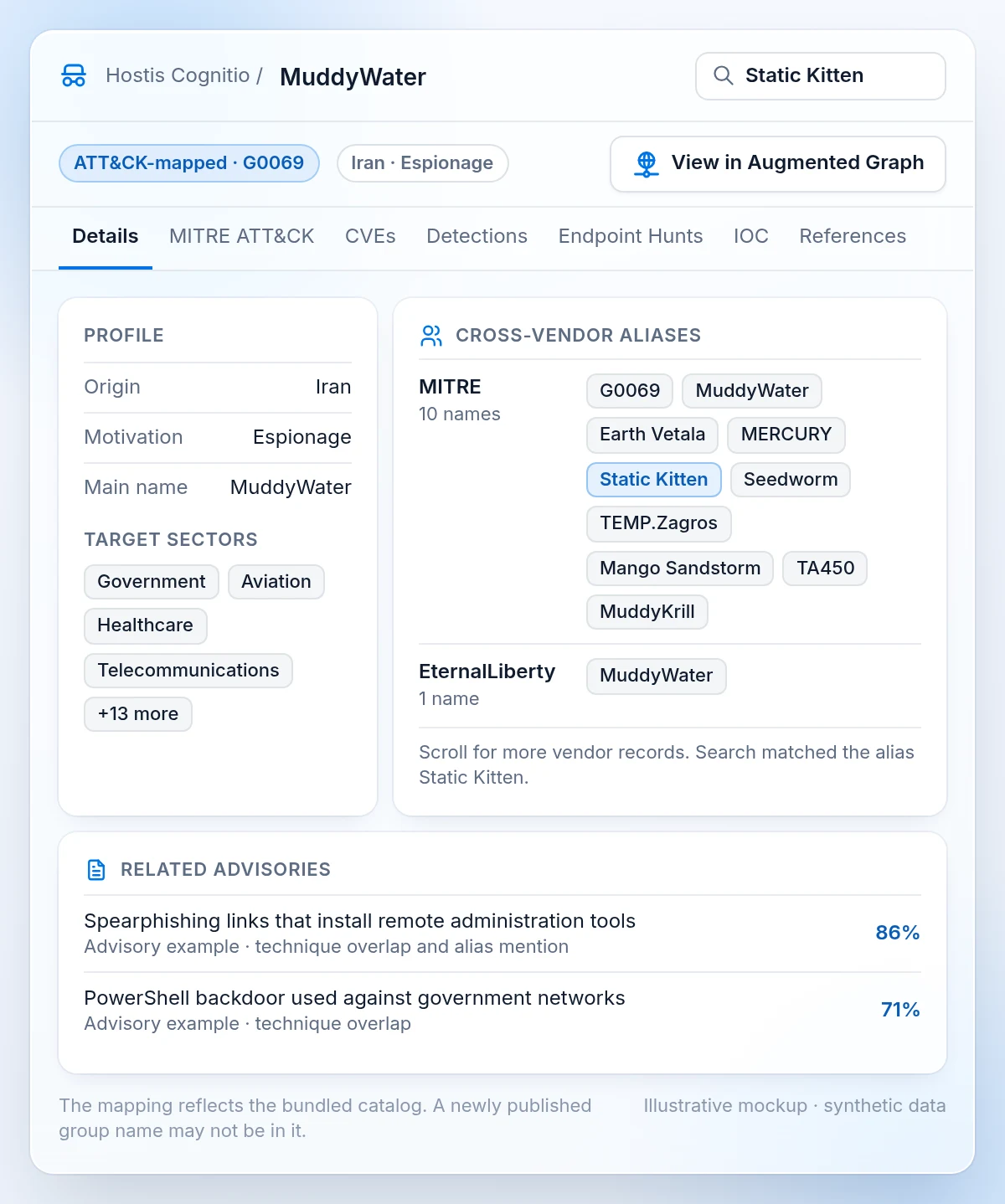
Cognitio, Imperum's threat actor intelligence module, brings threat-actor profiles and security advisories into one research workflow. Searching a recorded alias such as Static Kitten can return the MuddyWater profile, with its origin, motivation and available ATT&CK mappings. The profile's Detections tab matches Sigma rules to the actor's group or techniques; matches depend on the rules your tenant has synced, and deploying one needs its own permission.
A name published on November 24 may not be in the bundled catalog. The mapping reflects the bundled catalog and is not a promise that every vendor name or attribution is known. The MuddyWater profile covers shared techniques, not KuboShell, and an intelligence link does not prove the actor reached your network.
Step 2: Scan for the report's indicators and unapproved remote tools
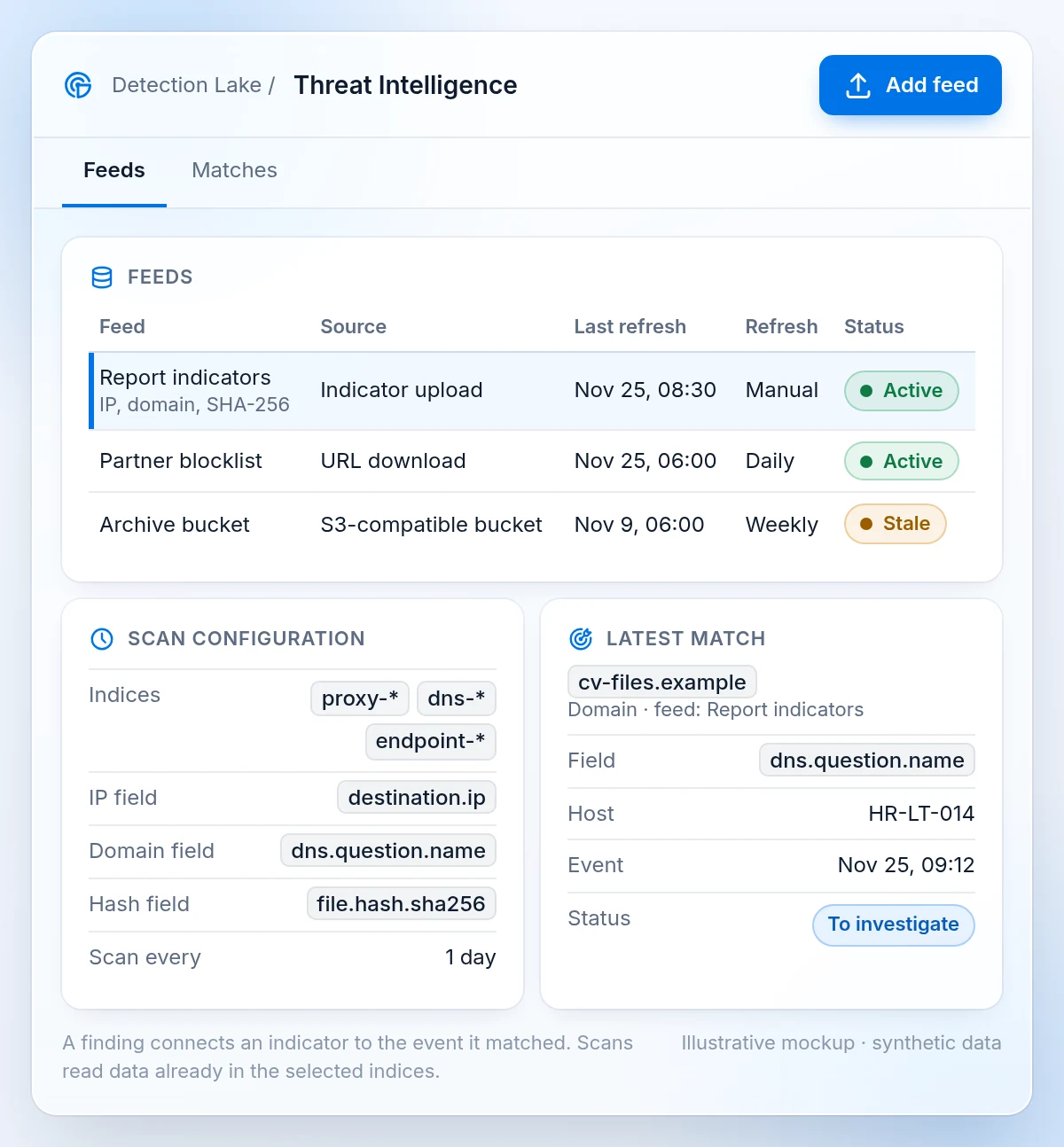
CPR's report ends with its indicators. In Detection Lake, Imperum's threat detection module, upload the SHA-256 hashes, IP addresses and domains as indicators, select the log indices and the IP, domain and hash fields to scan, and set the schedule. A finding connects an indicator to the event it matched.
Indicators move: on October 11 the group re-routed a domain to a new server. Also write or import a Sigma rule for remote management agents you did not approve, such as NetLock RMM or MeshCentral, and test it against compatible log data before you deploy it. The data must already be in the relevant indices, and importing a rule alone does not establish detection coverage.
Step 3: Investigate a reported CV with the Email Phishing agent
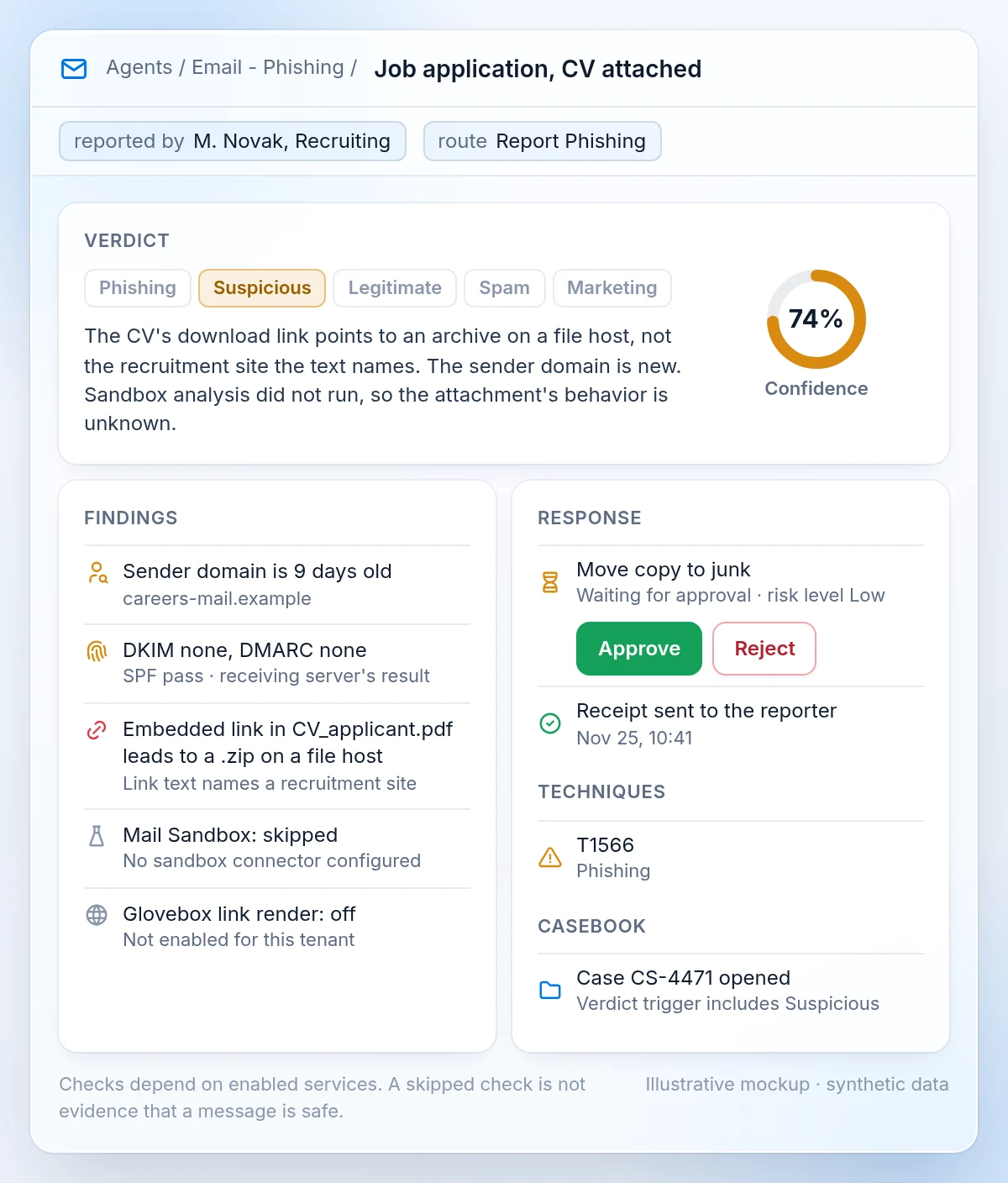
CPR does not say how the CV reached anyone. If a file like it arrives by email and someone reports it through a configured route, the Email Phishing agent, Imperum's native agent for reported email, investigates it. It unwraps forwarded content, examines authentication headers and sender information, and extracts links and attachments. Optional intelligence and sandbox services add checks when configured, and a skipped check "should not be treated as evidence that a message is safe."
The result is a verdict with the evidence behind it. Actions above the risk level you set wait for approval, and a Casebook case opens when case creation is enabled and the result meets its configured verdict rules.
What should you check this week?
- Search your logs for the indicators in CPR's report, as in proactive threat hunting, and treat a match as a lead, not proof of a breach.
- List the remote management tools you approve, and look for NetLock RMM, N-able RMM or MeshCentral where nobody approved them.
- Check whether your threat intelligence still files this activity under MuddyWater alone.
- Tell recruiters where to report a CV that sends them to another site for the full version.
Questions about APT groups and Volant Manticore
What are APT groups?
APT groups, short for advanced persistent threat groups, are threat actors that run long, targeted campaigns, often for a state. Each research team names the clusters it tracks, so one group can carry many names: MITRE ATT&CK lists MuddyWater with aliases including Static Kitten, Mango Sandstorm and Seedworm. A new name can mean a new group.
What are the types of threat actors?
Lists of the types of threat actors usually sort them by motive: state-aligned groups after intelligence, criminals after money, and hacktivists after attention. In ENISA's 2025 report, hacktivism made up almost 80% of the incidents it analyzed, mostly through low-impact DDoS campaigns, while state-aligned groups stepped up their operations against EU organizations.
Was the Cyprus airline breached?
No breach has been confirmed. Check Point Research found the fake CV on VirusTotal and assesses it was aimed at a Cyprus airline flying mainly to Israel, without naming the airline. Cyprus's deputy minister for digital policy said the competent services examined the reports and no breach emerged, and Cyprus Mail notes no such attack has been reported.
Can threat intelligence tools recognize a newly named group?
Only after a source or catalog records the name. Threat intelligence tools map aliases to profiles from the data they hold, so a name published on November 24 may be missing for a while. Until then, start from what the report gives you: the techniques, the indicators and the parent group the researchers compare it with.