 Start with onboarding



SOC as a service is a subscription model in which an external team runs some or all of your security operations center (SOC): monitoring, alert triage, investigation and incident response. An MSSP usually manages and monitors security controls, while an MDR provider focuses on detecting threats and acting on them. The right choice depends on who owns the response.
The three labels overlap, and providers use them differently. In this article we compare the service models by what they actually deliver, list the questions that separate one offer from another, and show what a provider's own tooling should make visible to you as the customer.
Key takeaways
- SOC as a service, MDR and MSSP are delivery models, not products, and the same provider may sell all three under different names.
- The most useful distinction is who investigates an alert and who decides on the response action: the provider, your team or both.
- Ask every managed SOC provider how tenants are separated, how response targets are set and how case priority is explained, because those answers shape your day-to-day experience.
What is SOC as a service?
SOC as a service is the delivery of security operations center functions by an external provider on a subscription basis. The provider's analysts watch your security telemetry, triage alerts, investigate the ones that matter and either respond or hand the case to your team. Many buyers use "managed SOC" for the same thing.
The scope of SOC as a service varies widely. Some offers cover round-the-clock monitoring only. Others include threat hunting, incident response and reporting. Some run on the provider's tooling and others on your own SIEM and EDR. Read the service description, not the label.
MDR vs MSSP: what is the difference?
The difference between MDR and MSSP is mainly about outcome. An MSSP (managed security service provider) typically operates and monitors security infrastructure and notifies you when something needs attention. An MDR (managed detection and response) provider typically investigates threats and takes response actions, such as containing a host, within an agreed scope.
In practice the line has blurred. Many MSSPs now offer detection and response tiers, and many MDR providers manage parts of the customer's stack. That is why searches for "mdr vs mssp" and "mssp vs mdr" rarely end with a clean answer. A comparison of the concrete commitments is more useful.
SOC as a service vs MDR vs MSSP: how do they compare?
SOC as a service, MDR and MSSP differ most in what they monitor, who acts and what you receive at the end. The comparison below describes common patterns. Any single provider may differ, so treat it as a list of questions, not a set of answers.
- Main focus. MSSP: operating and monitoring security controls. MDR: detecting and responding to active threats. SOC as a service: running SOC functions on your behalf, from monitoring to incident response, depending on the scope agreed.
- Who acts on an alert. MSSP: often notifies your team, which responds. MDR: investigates and takes agreed response actions. SOC as a service: depends on the service level, from notification to full response.
- What you receive. MSSP: alerts, tickets and device reports. MDR: investigated incidents with containment actions and findings. SOC as a service: cases, reports and response records within the agreed scope.
- Tooling. All three may use the provider's stack, your existing SIEM, EDR and SOAR, or a mix of both. Ask which, and who owns the data and the configuration.
- Fit. MSSP suits teams that want infrastructure managed and keep response in-house. MDR suits teams that want threats handled with limited internal staff. SOC as a service suits teams that want to outsource a defined set of SOC functions.
How do you choose a managed SOC provider?
Choose a managed SOC provider by deciding what you want to keep in-house before comparing offers. When you know which decisions your team keeps, the right category usually follows. We suggest working through these steps in order.
- Decide who owns response. Write down which actions, such as isolating a host or disabling an account, a provider may take without asking, and which need your approval.
- Map your current stack. List the SIEM, EDR and other tools you want to keep, and ask each provider whether they work with them or replace them.
- Ask how your data is separated from other customers. A provider serving many tenants should be able to explain how analysts are kept in the right customer context.
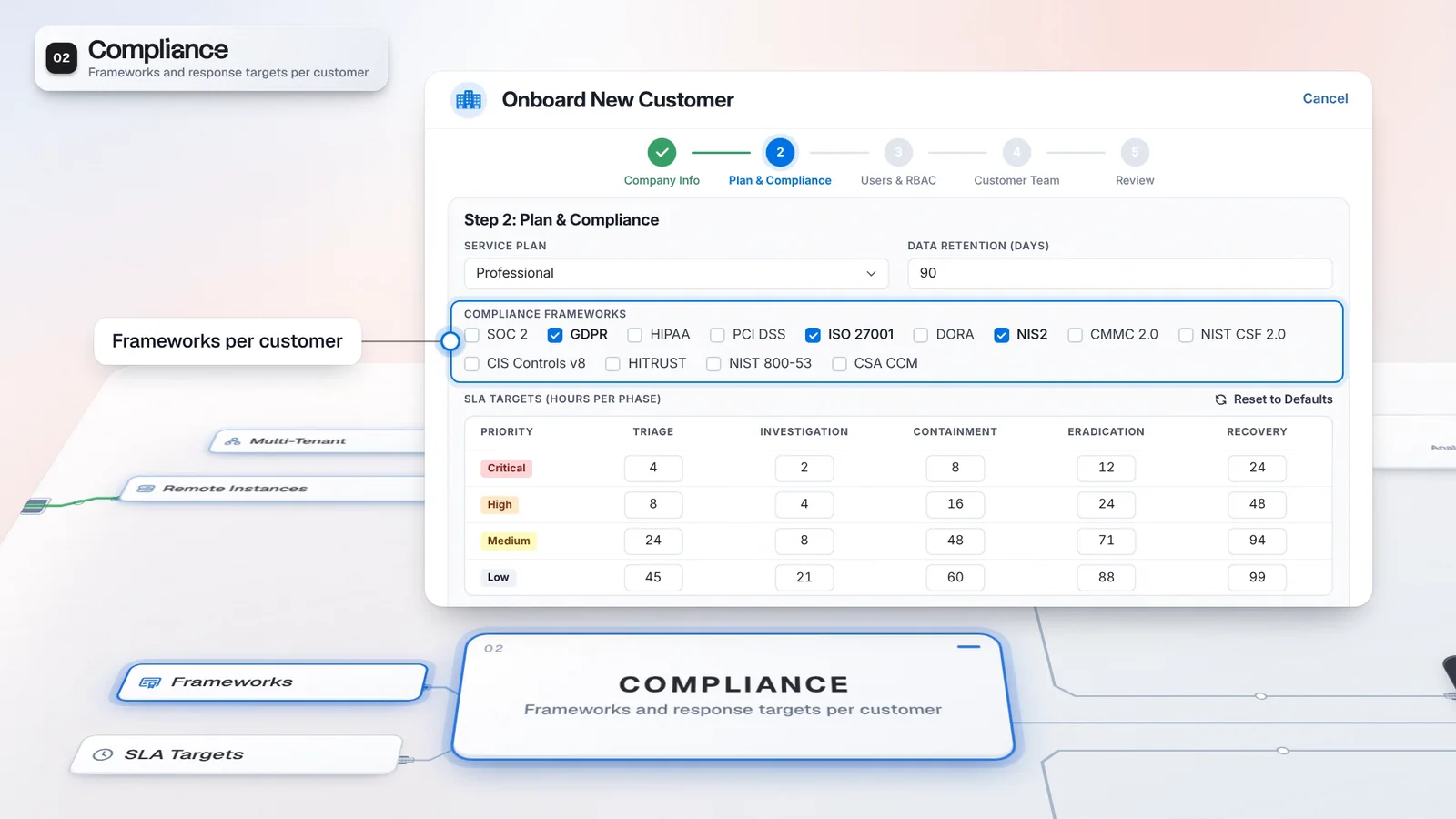
- Ask how response targets are defined. Look for targets per priority and per investigation phase rather than a single number, and confirm whether they are targets or contractual guarantees.
- Ask how case priority is set. A severity label alone says little; ask what evidence feeds the priority and whether analysts can see and change it.
- Ask how cases are assigned. Find out whether the analyst handling your case is chosen for relevant skills and how handovers keep your context.
- Ask what you will see. Clarify how you submit requests, track them and review what was done on your behalf.
What should a provider's tooling make visible?
A provider's tooling decides how well the questions above can be answered. Imperum The Portal is a multi-tenant console for MSSPs and MDR providers that brings multi-tenant oversight, case prioritization and analyst routing to the security tools the provider already runs. It is a useful example of what to ask about, whichever provider you choose.
- Tenant scope. Customers and sub-tenants are organized in a hierarchy, and tenant-aware alerts and case access help analysts stay in the intended customer context. Broader views require the relevant permissions.
- Service targets. Response targets are set per priority and investigation phase for each tenant, with inheritance from parent and global settings. The page is explicit that these are service targets, not a guarantee of response time.
- Evidence behind priority. Case Prioritizer combines a case's available signals into a weighted risk score with a breakdown. A case with no underlying evidence keeps its priority, and analysts can review the result and change it.
- Assignment. Case Router weighs declared skills and training alongside case history, workload and seniority to give a reasoned shortlist. Routing defaults to Off, and the router does not automatically assign new cases unless the provider enables automatic routing.
- Existing stack. The Portal is a distinct edition for providers keeping their SIEM, EDR and SOAR. Integration depends on supported connectors, customer configuration and permissions.
The customer request portal, which handles request intake and tracking, is a separate feature that can be enabled and configured; it is not part of The Portal edition itself. AI agents, playbook automation, detections and endpoint collection are outside The Portal's default module set and come with the Autonomous SOC and SecOps Platform editions.
Where does human judgment stay?
Human judgment stays with whoever the contract says owns each decision, so make that explicit. Outsourcing monitoring does not outsource accountability for a breach. Your team still decides risk appetite, approves high-impact actions you have not delegated, and owns communication with the business.
Also check the prerequisites. Any managed SOC depends on the data it receives, so confirm which log sources and tools are connected, which permissions the provider holds and which actions those permissions allow. A provider cannot act on telemetry it never sees.
Frequently asked questions
What is SOC as a service?
SOC as a service is a subscription model in which an external provider runs security operations center functions for an organization. Depending on the agreed scope, this covers monitoring, alert triage, investigation, threat hunting and incident response. It is often called a managed SOC, and the exact services differ between providers.
Is MDR the same as a managed SOC?
MDR and a managed SOC overlap but are not always the same. MDR typically focuses on detecting and responding to threats, often with response actions taken by the provider. A managed SOC can be broader, covering monitoring, reporting and other SOC functions, or narrower when response stays with the customer.
Do we have to replace our SIEM or EDR to use a managed SOC provider?
Not necessarily. Some providers bring their own stack, while others work on top of the tools a customer already runs. Ask each provider which of your tools they support, who holds the configuration and data, and which response actions their access allows in your environment.
Are response targets the same as guaranteed response times?
No. A response target describes what the provider's service aims for, often per priority and per investigation phase. A guaranteed response time is a contractual commitment with consequences if it is missed. Read the service agreement to see which one a provider is offering.
Next step
Start by writing down which response decisions you want to keep and which tools you will not replace, then use the seven questions above in every provider conversation. If you run a managed service yourself, see how The Portal handles tenant context, case priority and analyst routing on top of the stack you already operate.